
Return to Machines for knifemakers

Rolling mill RM-1


+++ Now available! Inquire today! +++

High thickness reduction is a common and yet one of the most time consuming steps in traditional forging. Especially the forging of damascus steel often requires the blacksmith to reduce material from 60mm to as low as a few millimeters thickness. The best machine to speed up this process is a rolling mill as it offers a quick and precise way of reshaping hot metals. Being free of noise and vibrations, a rolling mill is suitable for every shop and gets the job done more efficiently than a power hammer or press.

Unfortunately, besides some occasionally offered second-hand goldsmith machines, there is no market for rolling mills that are suitable in size and price for most blacksmiths.

Until now, that is: The Tobin RM-1 ist the first machine to offer a robust and affordable package. Designed and built in Austria, the machines have a very high build standard. Increase your productivity, be it with making damascus steel, pre-shaping steels from large stock sizes or for making tools and artwork of all kinds.
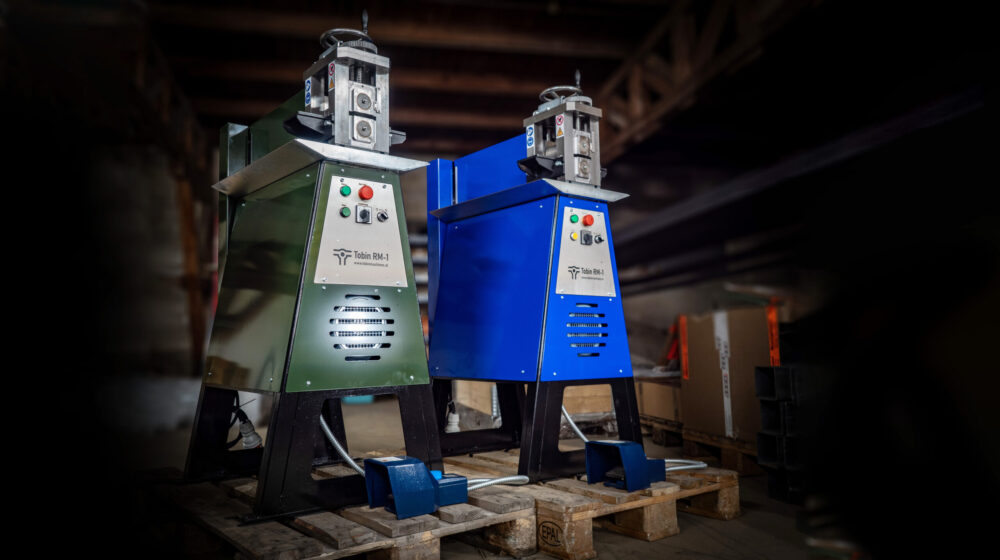
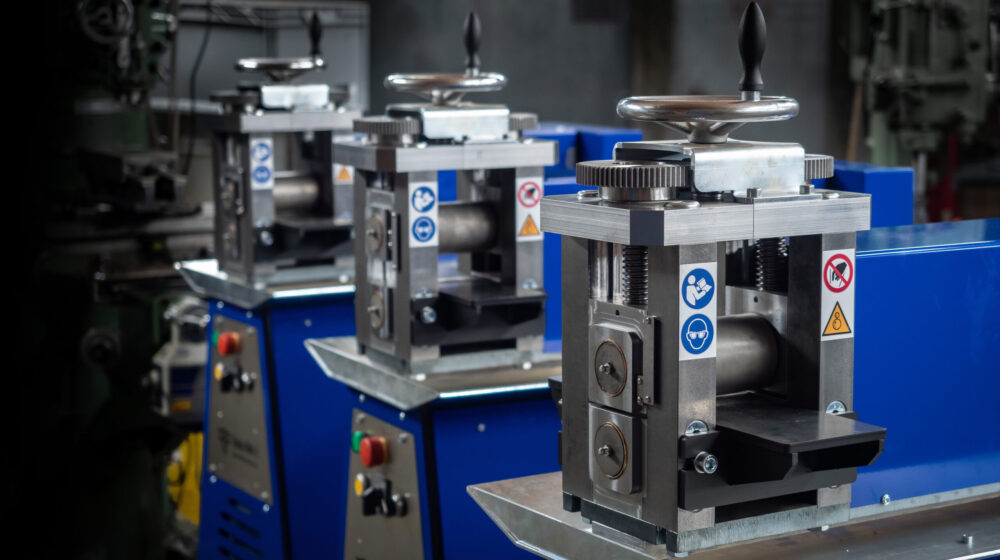
The RM-1 is also suitable for research and development where it is used for bringing material samples to a precise shape, introducing defined internal stress states and testing formability of materials. It can be equipped with sensors to measure forming speed, rolling force and torque and is also available in a variable speed option. If you have such applications or other specific needs, let’s talk!

+++ How to order +++

RM-1

Get to know the RM-1!

Click the marked regions in the picture to learn more!

RM-1
Small footprint Power source Operator panel Pedal switch Drivetrain Coating

Small footprint

The RM-1 has a footprint of only 850 x 650 mm and is thus more compact than e.g. the euro-pallet displayed.

Power source

Please not that a 3x400V supply is needed to run the RM-1. A special version with VFD is available to run the RM-1 from 1x230V (1x240V for North America).

Operator panel

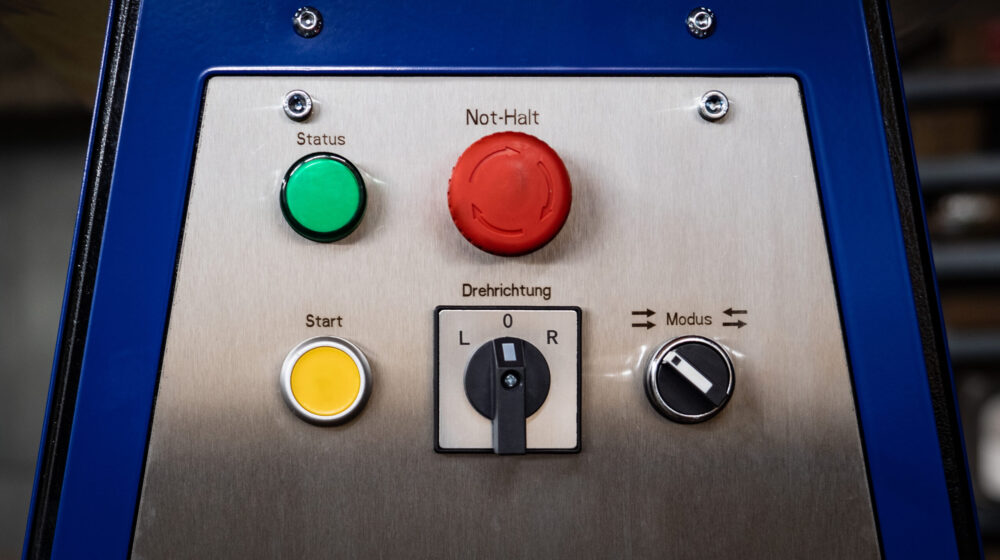
The control unit offers two operation modes that can be selected on the panel:

  • continuous mode, draw out workpieces in constant direction with a helper to return the piece
  • reversing mode, draw out workpieces alone and easily switch the direction to return the piece to the original side of the machine.

Pedal switch

The machine is started using the pedal switch. The pedal has an emergency-stop function that is triggered when heavily stepping on the pedal and stops the RM-1 immedaitely.

Drivetrain

  • 3kW Motor with spur gearbox and brake
  • European quality product
  • secondary transmission with chain
  • safety clutch to prevent overload

Coating

  • lower frame: powder coated, RAL 9005
  • covers: powder coated, RAL 7016 (other colors upon request)
  • structural sheet components in roll stand: zinc plated
  • other parts of roll stand: steel uncoated

RM-1: Roll stand

Get to know the RM-1!

Click the marked regions in the picture to learn more!

RM-1: Roll stand
Rollers Bearings Ball joints Thickness adjustment Scale pan Ruler

Rollers

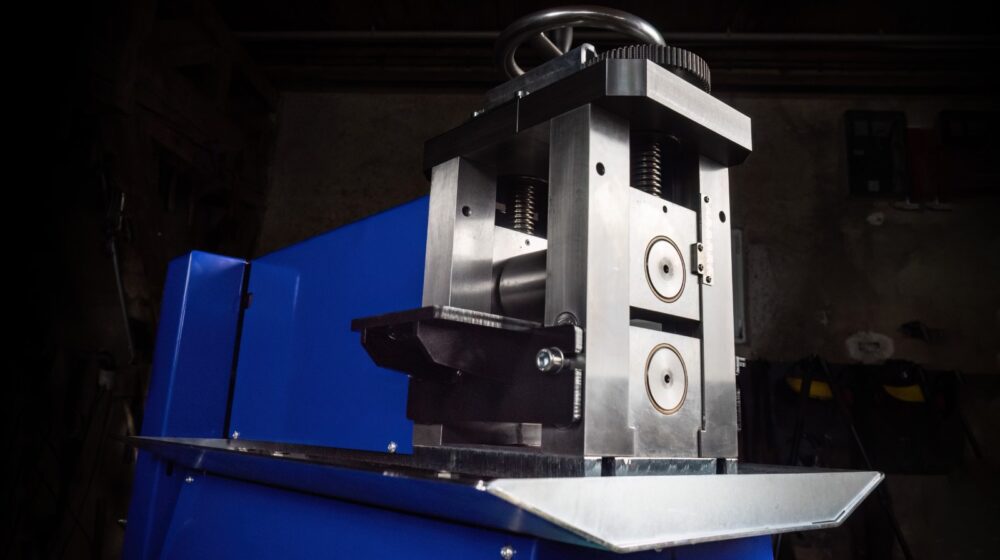
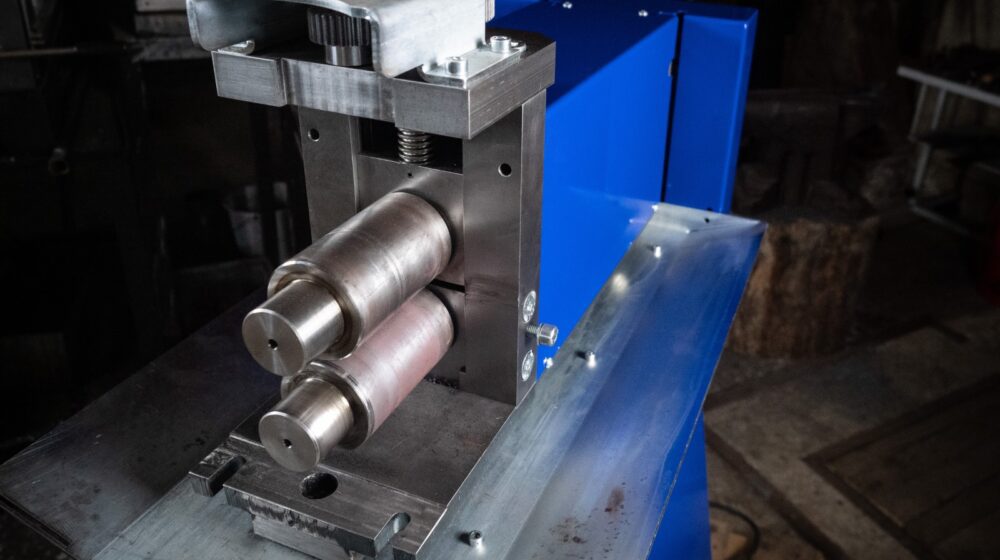
The rollers, made of quenched and tempered 42CrMo4 steel, are additionally nitrided, achieving a surface hardness equivalent to 75 HRC.

  • roller diameter: 70 mm
  • width clearance: 110 mm
  • depending on material, temperature, width, and thickness, the infeed can be up to 3.5 mm per pass.

Bearings

The rollers run in bronze bearings with lubrication pockets. This bearing system has proven itself for high-load bearings in harsh environments (heat, dirt). The bearings can be conveniently lubricated from the outside using grease nipples.

Ball joints

Unlike simpler offerings from the goldsmithing sector or DIY solutions, both rollers on the RM-1 are synchronously driven by heavy-duty ball joints. The advantages are obvious:

  • symmetric forging
  • larger possible infeeds due to better friction
  • enables usage of pattern rollers

Thickness adjustment

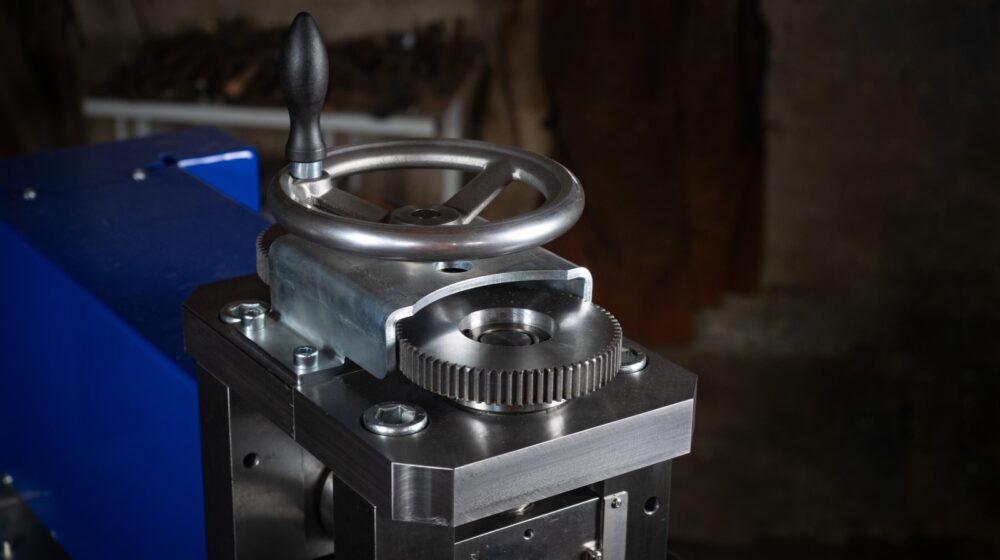
Before the rolling process, the rollers are adjusted to the desired final thickness using a hand crank. The gear ratio is chosen so that one revolution corresponds to exactly 2 mm, which makes counting easier.

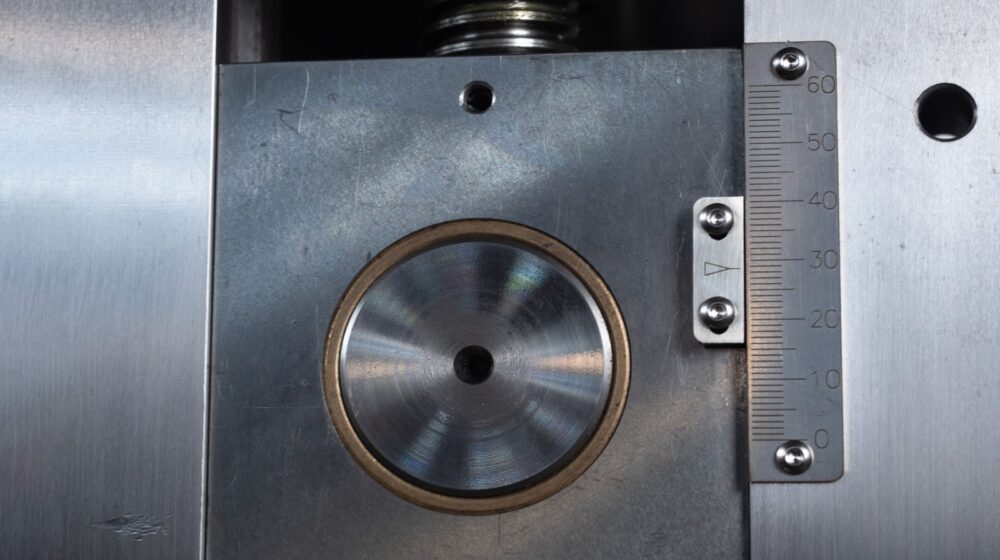
Thickness range: 0-60mm

Scale pan

Falling mill scale is collected in the scale pan and can be easily swept out from there.

Ruler

The RM-1 is equipped with a ruler for thickness adjustment as standard. A digital readout system is available as an option.

Digital Readout

The digital readout system can be ordered optionally instead of the thickness ruler. It features a self-illuminating display and a resolution of 0.02 mm. The system is powered directly by a power supply in the RM-1 and does not require external connection.

Digital Readout

Twisting attachment

The RM-1 can be equipped to hot-twist bars up to 40mm square. Combined with the pattern roller system, this upgrade makes the RM-1 the ideal machine for demanding damascus blacksmiths!

Twisting attachment
Counterholder Chuck Roll stand Twisted damascus Video

Counterholder

The counterholder rests on the guide rods and can be moved freely. The workpiece is clamped with screws.

Chuck

The chuck is slid onto the shaft of the roller. Inserts are available for different square sizes.

Roll stand

The use of the roll stand of the base machine is not affected by the torsion attachment.

Twisted damascus

Pattern rollers

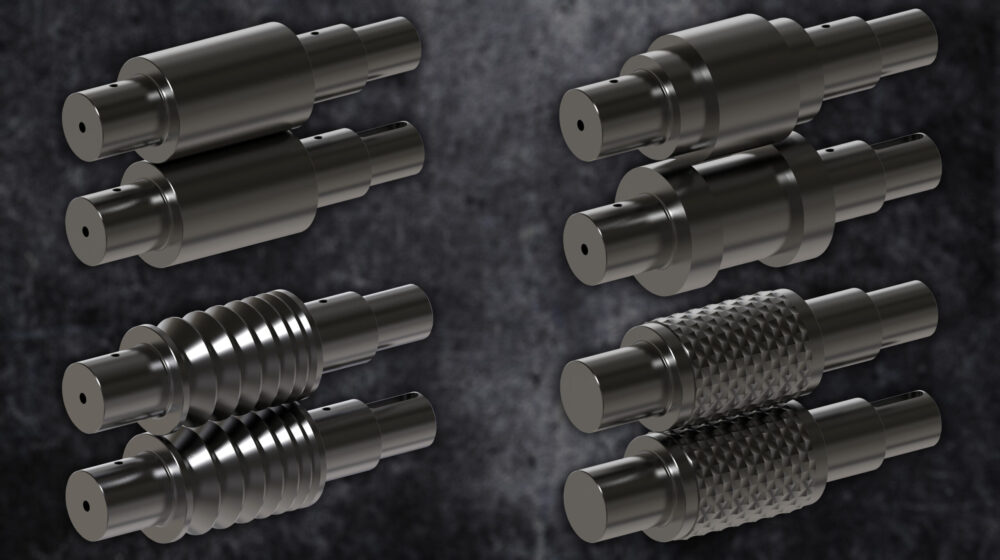
The RM-1 can be expanded with an additional roll stand that allows the use of different embossing and profile rollers. The pattern rollers run parallel to the main rollers of the base machine and can therefore be used simultaneously without reconfiguring the RM-1. If it's necessary to switch between patterns, the extra rollers can be swapped extremely quickly.

Pattern rollers
Pattern rollers Pattern "Pyramids" Thickness adjustment Swapping rollers Video

Pattern rollers

The embossing rollers are manufactured to the same quality standards as the main rollers. The additional stand's passage width is 100 mm.

Please inquire to learn about the available embossing patterns!

Pattern "Pyramids"

Please inquire to learn about the available embossing patterns!

Thickness adjustment

The additional stand is coupled to the feed mechanism of the base machine and moves together. The thickness range, also with the additional stand, is 0-60 mm.

Swapping rollers

Swapping the pattern rollers is child's play: Two bolts need to be loosened. Then the additional stand is sled outward along the guide rods. The pattern rollers are then removed and replaced without tools.

  • Rollers: 42CrMo4, quenched, tempered and nitrided, diameter 70 mm
  • Workpiece thickness: 0-60 mm
  • Workpiece width: max. 110 mm
  • Drive system: Electric gear motor 3 kW with brake, secondary transmission with chain
  • Thickness reduction depending on temperature, material and workpiece shape up to 3.5 mm.
  • Operation mode 1: continuous mode, draw out workpieces in constant direction with a helper to return the piece
  • Operation mode 2: reversing mode, draw out workpieces alone and easily switch the direction to return the piece to the original side of the machine.
  • Thickness ruler for precise manufacturing
  • Adjustable safety clutch prevents overload
  • CE certified design with safety pedal switch
  • Bearing system based on bronze bearings, lubrication points easily accessible
  • Easy to clean design
  • Only high-quality components
  • Structural parts are coated or painted
  • Weight and size: 260 kg, 850x650x1600 mm
  • A floor plan for space requirements can be found in the manual

Options

  • RM-1 base machine
  • Digital readout
  • Expansion packs
    • Twisting attachment
    • Additional roll stand to run pattern rollers
    • Pattern- and profiling rollers in various shapes
    • For these expansion packages, the RM-1 base machine is equipped with extended rollers featuring an outwardly elongated shaft to drive the expansion tools. Additionally, reinforced roll tables are mounted to accommodate the guide rods. These modifications can either be prepared when assembling the RM-1 or retrofitted later (no special tools required).
  • Caster wheels for the machine frame
  • VFD so that the machine can be operated on 1x230V (240V for the American market).

Other modifications

For R&D applications, the machine’s functionality can also be expanded:

  • force transducers
  • torque sensoring
  • forming speed measurement
  • variable speed
  • extension of the rolling width

If you have such applications or other specific needs, let's talk!

Prices

Current prices are available upon request! A deposit may be required to order the RM-1.